
Over the years, our family has lived in South Korea, Denmark, China, and Spain.
I’ve also had the opportunity to travel with my children to different countries and cities, experiencing new cultures and seeing different parts of the world.
As my children grow older, I’ve come to realize that cross-cultural education isn’t simply about how many countries children have visited. More importantly, it’s about learning how to connect and communicate with people from different cultural backgrounds, and how to understand a world that may be very different from the one they’re familiar with.
Cross-cultural education is not just about broadening children’s horizons or improving their communication skills. It’s also about helping them develop empathy as they learn to understand differences (Philippians 2:4), show respect and care for others (Romans 12:15), and put the command to “love your neighbor as yourself” (Mark 12:31) into practice in everyday life.
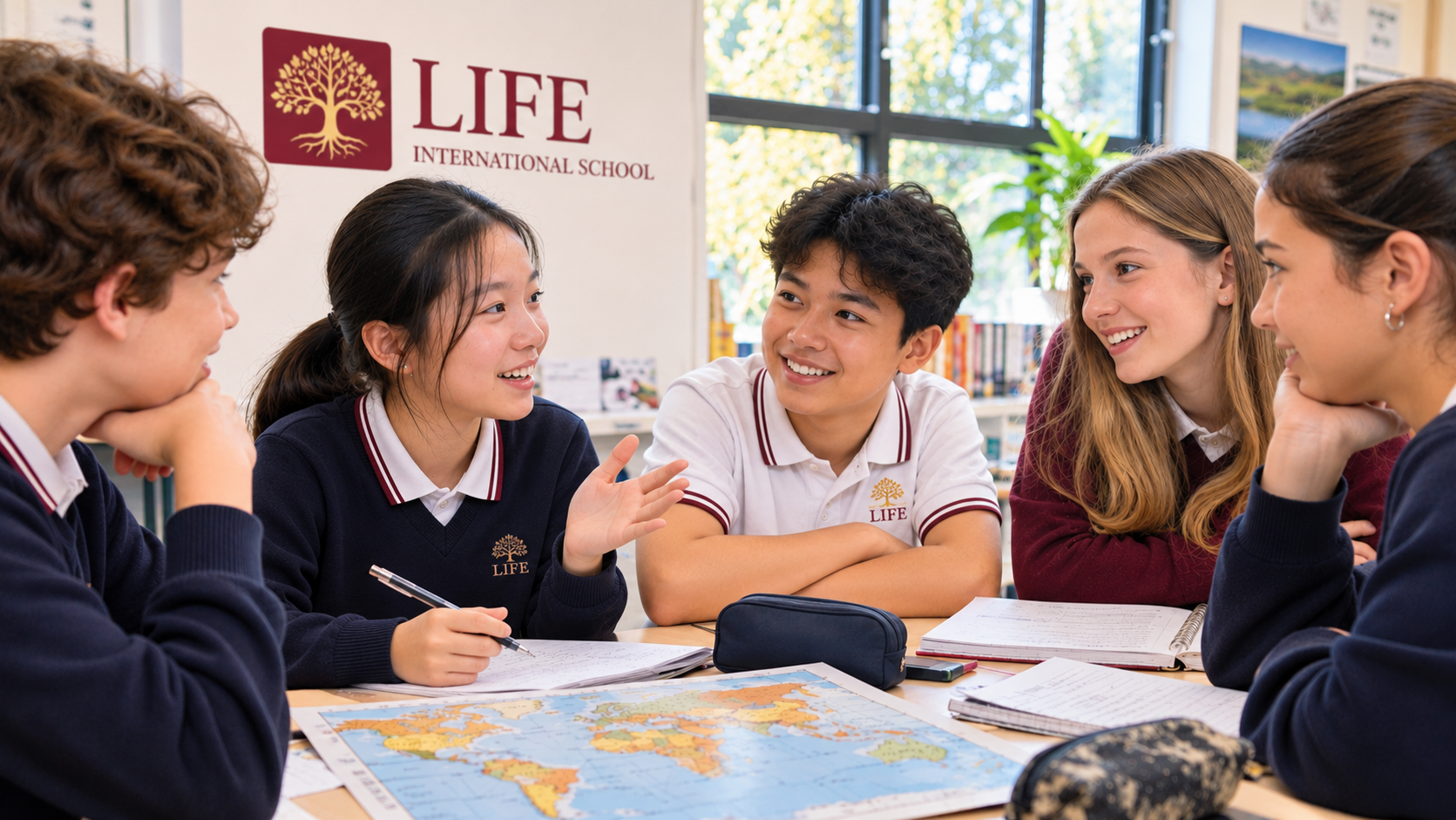
LIFE is an American international school in Spain, with students representing more than 30 nationalities. Here, cross-cultural learning isn’t just something children read about in books. It’s part of their everyday school experience.
They share classrooms with students from different countries, work on projects together, discuss ideas, play sports, and experience all the little joys and occasional disagreements that come with friendship.
I believe this kind of environment offers children something that goes far beyond learning another language.
1.Seeing Differences
At LIFE, my two children have friends from different countries, including the United States, Spain, and the Philippines.
Out of curiosity, they learn words from each other’s languages, discover different cultural traditions, and share their thoughts about all kinds of things. Sometimes they agree, and sometimes they see things quite differently.
For example, my daughter was surprised to learn that in Spain, some babies have their ears pierced when they are very young.
This seemed unusual to her because, in the school environment she was familiar with in China, students generally weren’t allowed to wear earrings to school.
Another example is something as simple as eating noodles. In Japan, slurping noodles is generally acceptable and can even be a way of showing enjoyment. In many Western countries, however, making noise while eating is often considered impolite.
In a cross-cultural environment, children quickly discover that people can see the very same thing in completely different ways.
And these differences aren’t necessarily about who is right or wrong.
When children begin to realize that their own perspective isn’t the only one, they have an opportunity to move beyond simple black-and-white thinking. They learn not to judge everything only by the cultural standards they’ve grown up with.
2.Understanding Differences
Of course, I hope my children will become fluent in English and Spanish. But through our experiences living in different cultures, I’ve learned that speaking a language well and communicating well are not necessarily the same thing.
When children from different cultural backgrounds work on group projects, join discussions, or disagree with one another, they need to learn not only how to express themselves, but also how to listen.
Sometimes, the same words can mean different things to people from different cultures.
And sometimes, we may think someone is being unfriendly when, in fact, they simply have a different way of communicating.
For example, in China, people sometimes greet each other by asking, “Have you eaten?” It’s a familiar way of showing care and concern.
But in American culture, asking someone “Have you eaten?” when you first meet them might seem a little strange. They may wonder why you’re asking!
In some Asian cultures, people may express themselves more indirectly or carefully, while in some Western cultures, people may be more comfortable expressing their thoughts and feelings openly and directly.
When children experience these differences in their everyday school life, they have opportunities to ask themselves:
- “Why does he think that way?”
- “How can I better understand what he’s trying to say?”
- “Would this situation look different from his cultural perspective?”
Learning to look at situations from different perspectives is an important part of developing critical thinking skills.
To me, the value of cross-cultural education isn’t simply helping children learn that different cultures exist. It’s helping them step outside their familiar ways of thinking, understand differences, and see the world with a more open and independent mind.
3.An Essential Skill in the Age of AI: From Understanding to Caring
As artificial intelligence continues to develop, more and more repetitive and routine tasks are becoming automated.
AI can help us translate languages, access knowledge, analyze information, and even work through complex problems.
These technologies are changing the way our children will learn, work, and live in the future.
Technology can help us do things more efficiently, but understanding, trust, and genuine care between people are still things we need to build ourselves.
When I think about the world my children may face in ten or twenty years, I hope they will be able to express themselves clearly, understand different perspectives, adapt quickly to unfamiliar environments, build meaningful relationships, and make a positive difference in the lives of others.
While children are still growing and need guidance from teachers and support from parents, LIFE’s multicultural environment gives them many opportunities to learn, through everyday interactions, how to understand and care for others.
At LIFE, Christian values are not only part of what children learn, but can also guide how they treat others and build relationships across cultures.
As both a mother and an educator, I feel truly grateful that my children have the opportunity to learn and grow in this environment.
To me, the true value of cross-cultural education lies in helping children move from seeing differences, to understanding differences, and ultimately, to responding to those differences with love.
 Lois Zhang – Marketing Coordinator East Asia at LIFE International School


