
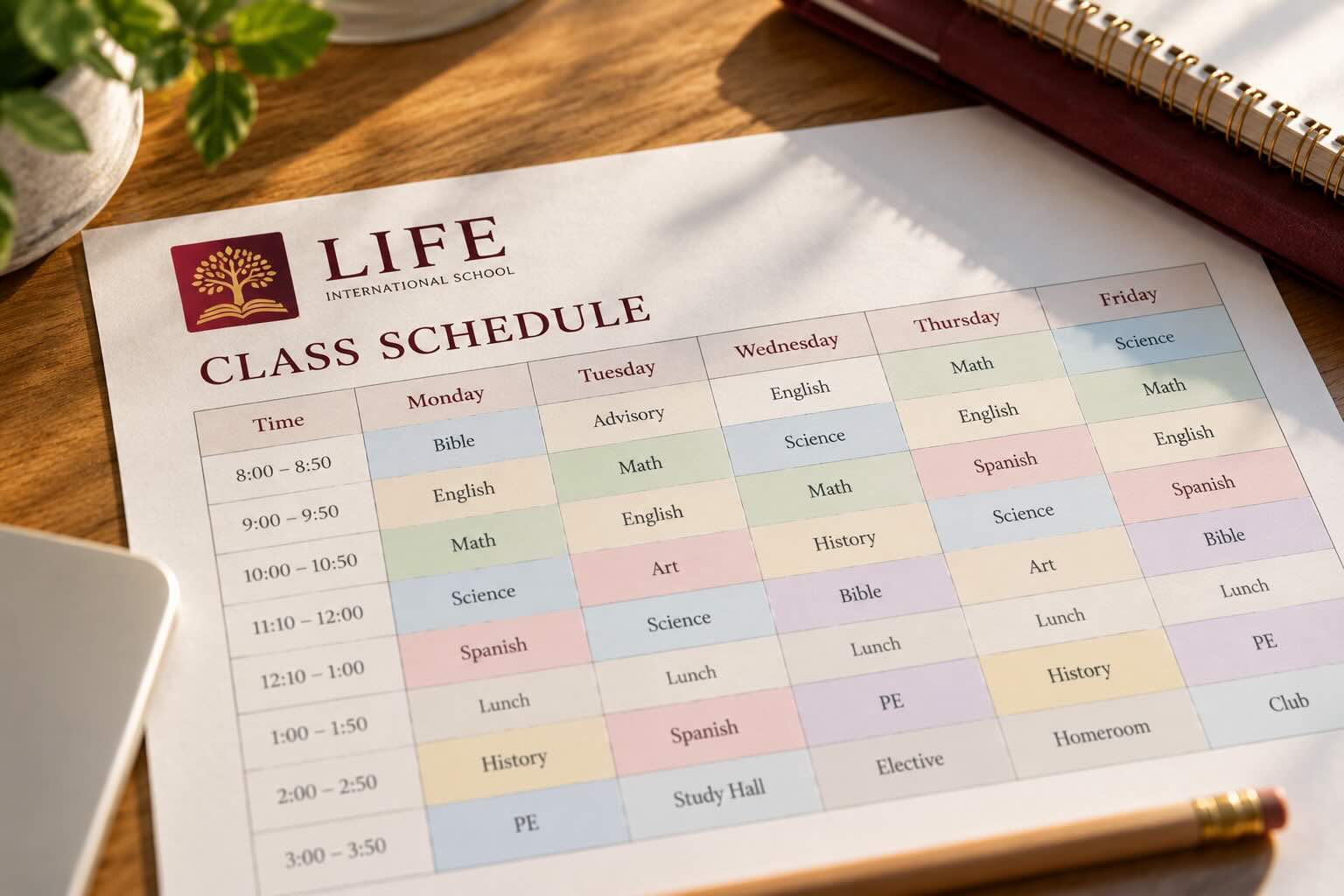
“One day, my daughter told me that her schedule was a little different from her classmates’. It seemed like a small thing, but it caught my attention. After many years in teaching, I know that arranging different courses for different students is never simple.”
— LIFE International School through the eyes of a Chinese mother and educator
Since joining the LIFE community, I’ve had the opportunity to see the school from two perspectives:
As a parent, I care about the quality of my children’s education and whether they’re getting the support they need.
As a school volunteer, I’ve also had the chance to see some of the work teachers and staff do behind the scenes to meet individual students’ needs.
1.Personalization, Even in the Class Schedule
One thing that has particularly impressed me is the way LIFE takes students’ different learning needs into account when planning their courses.
When a student is ready for more advanced work in a particular subject, the school may consider placing them in a higher-grade class, depending on their individual situation. Students who need extra help can receive academic support.
The school also offers Spanish language instruction and related coursework to meet different students’ needs.
At the high school level, students may also have opportunities to pursue advanced coursework, including Honors and AP options, depending on availability and their individual academic pathway.
2.Supporting Students Who Are Learning English
For students whose first language is not English, LIFE assesses their English proficiency during the enrollment process and uses that information to identify appropriate language support.
As a Chinese mother, I find this especially meaningful.
Children of the same age can arrive from different countries with very different levels of English. Some may speak confidently in everyday conversations but still struggle with academic reading and writing. Others may be adjusting to an English-speaking classroom for the first time.
They need different kinds of support.
Rather than assuming that all English language learners have the same needs, the school makes an effort to understand each student’s starting point and consider what kind of help would be most useful.
3.A Schedule Is More Complicated Than It Looks
As parents, we usually see the finished schedule: which classes our children have, where they need to be, and who their teachers are.
But even a small adjustment can involve more coordination than we might imagine.
The school has to consider each student’s academic background and learning needs, while also working around teachers’ schedules, classroom availability, course requirements, and coordination between departments.
Sometimes, finding a better arrangement for just one student may involve several rounds of discussion between teachers, academic leaders, and other staff members.
From a school management perspective, that’s no small task.
It would certainly be easier if every student in the same grade followed exactly the same schedule.
But children don’t all learn in the same way or at the same pace. Even students in the same grade may have very different academic backgrounds, language abilities, interests, and learning needs.
To me, personalized education doesn’t mean allowing children to study whatever they want.
It means making an effort to find an appropriate learning path for each student whenever possible, while respecting academic standards and working within the school’s available resources.
That takes more than a good educational philosophy. It takes time, thoughtful decisions, teamwork, and a willingness to put those ideas into practice.
4.From Educational Philosophy to Everyday Practice
Over the years, I’ve lived in four countries and visited many different kinds of schools.
Many schools talk about being “student-centered,” respecting individual differences, or supporting the development of the whole child.
These are wonderful ideals, and I’ve come to appreciate how much thought and effort it takes to put them into practice.
- What happens when a student’s needs don’t quite fit the existing course structure?
- How does a school respond when children arrive with different language backgrounds, academic abilities, or learning experiences?
- And when supporting an individual student means extra work for teachers and staff, is the school still willing to explore what might be possible?
These may seem like small, practical questions, but to me, they offer a glimpse into how a school’s educational values are reflected in everyday decisions.
At LIFE, I’ve begun to notice these values in small but meaningful ways: an adjustment to a class schedule, a conversation between teachers, or the extra time someone takes to find a way to support a student.
Of course, no school can meet every need of every child. Schools must constantly balance their educational goals with the time, staff, and resources available.
But the willingness to recognize individual differences and make a genuine effort to respond to them is something I deeply appreciate.
It has also helped me better understand what LIFE means by holistic education.
5.Seeing Beyond Grades
As a mother, I naturally care about my children’s grades, their academic progress, and their future educational opportunities.
At the same time,I’ve come to believe that children can be encouraged to work hard, think deeply, and pursue excellence, while still receiving the individual support they need along the way.
Academic expectations and care for the whole child don’t have to compete with each other. They can work together.
I’ve also come to appreciate more deeply what Christian education means at LIFE.
It isn’t simply about adding Bible classes to an academic program. It’s about recognizing the value of each child as a unique individual and allowing that belief to shape everyday teaching and school life.
Each child has different gifts, strengths, and areas where they need support.
Education is not only about helping children meet academic expectations. It’s also about walking alongside them as they discover their abilities, develop their character, and grow into the unique people God created them to be.
When I look at my daughter’s class schedule now, I see more than a list of subjects and times.
I’m reminded of the thoughtful conversations, and care that may go into supporting an individual student’s learning.
And perhaps that’s what has impressed me most: not simply the idea of personalized education, but the willingness to do the everyday work needed to make it happen.
 Lois Zhang – Marketing Coordinator East Asia at LIFE International School


